
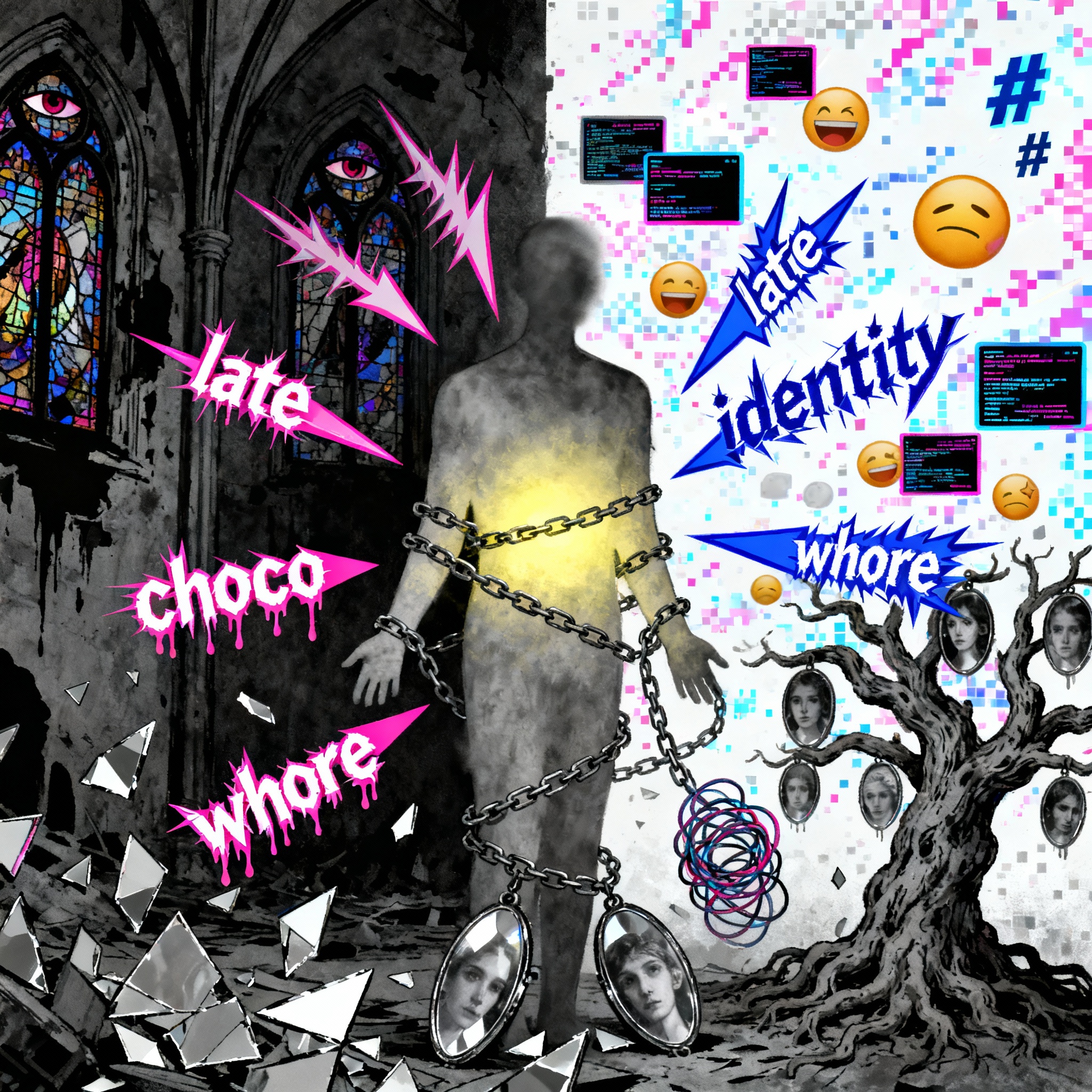
“People keep weaponizing words and aiming them at me (me as a concept for not repeating the short force in the lineage) . ‘Late’ is one of them. In my family, it was used in a grotesque, pseudo-biological way—like saying that if a baby stayed a few minutes longer in the mother’s womb, they would be born gay. Difference was treated as a developmental error rather than a human fact. Now, because I’ve been around gay people, some act as if sexuality were a defect, a contamination, or even a disease—something you ‘catch’ by proximity. At the same time, ‘late’ is stretched to imply a wrong or excessive body, and to suggest mental slowness or retardation. One word ends up carrying accusations about sexuality, body, and intelligence all at once. Then there’s ‘choco’ and ‘chocolate’. In Portuguese, it gets dragged into chocar—to collide, to shock, to crack eggs, to cause impact. I stop being a person and become a metaphor for something malformed, something that didn’t hatch correctly, something that hit instead of arrived. It’s wordplay pretending to be meaning. I can’t ignore my family structure. I believe my father married my mother because his desire was constrained within a narrow, racialized idea of who he could have as lovers. That framework shaped how bodies, women, and worth were silently ranked around me. Looking at my own history, I see patterns that scare me. I’ve often been drawn to the wrong men—men too close to me in a genetic or familial sense, crossing boundaries that should have been protected. That confusion didn’t come from nowhere. There’s another layer that worries me deeply: the short, closed lineage I come from already operates through control—of bodies, of choices, of women. I can feel how strong that pressure is inside me. If I don’t actively change it, consciously and structurally, it feels like a recipe for disaster—not fate, but repetition. With hindsight, I see another trap. If I had known earlier that remaining in certain social circles—where, in a country already scarce in tall blond men, my options would shrink even further—would push me toward repeating my parents’ physical and relational patterns, I would have left sooner. Not out of rejection, but out of self-preservation. Now I feel cornered. Trapped inside the Church’s moral frame, where I’m told to be pure, patient, and invisible. At the same time, it feels like being sexual online—being reduced to a ‘whore’—is presented as the only way to reach men who are not genetically or socially close to me. That path collapses too: those same men will say I’m a whore, that I disqualified myself, that I should have been ‘decent,’ that I should have taken a cooking class years ago in some far-away land. As if virtue were logistical. I know things are difficult here. When my psychoanalyst saw my photos, all he could think about were moral corrections. He clarified nothing. He judged me as worthless. He gave me no solution. He didn’t listen when I said many things—and I didn’t listen to myself either. Men seem to believe that avoiding the internet automatically equals success—success in work, masculinity, life. I don’t even know exactly what they mean, but they assume I don’t understand their logic. It likely has to do with pregnancy, control, and ownership. They treat sexual access as achievement, without building anything real. Their definition of success was never aligned with what was actually happening to me. And there is a cost. They will pay it, and they will accept it—because women are also being pushed to punish themselves while men continue the same patterns. There’s an urgency I can’t shake. It feels like this has to be said through art—especially to women in this country who end up with many children and a partner who becomes a tragedy in their lineage because the same structures are repeated again and again. I don’t know if I’m right to feel this urgency, or if having these thoughts makes me seem ‘crazy.’ Sometimes I wonder if the real madness isn’t the opposite: believing that multiplying the same structure—same man, same control, same silence—counts as change, while questioning it is treated as deviance. Meanwhile, I binge-eat the way some people use drugs. I know I have real problems. I’m aware of them. I’m scared. What hurts is that instead of care or clarity, everything gets flattened into metaphors, puns, moral judgments, and double binds. So I keep asking: what do people actually want from me—repair and understanding, or just a convenient surface onto which they can project fear, control, and inherited prejudice?”
Your dream suggests a deeply introspective and emotionally charged reflection on identity, societal expectations, and the struggle for self-acceptance amid familial, societal, and personal challenges. Here are some key interpretations of the main themes in your dream:
Weaponization of Words:
Family Dynamics:
Sexuality and Identity:
Control and Conformity:
Patterns and Repetition:
Struggle with Societal Norms:
The Need for Expression:
Inner Conflict and Self-criticism:
Desire for Understanding and Repair:
This dream encourages you to explore these themes further in your waking life, perhaps through creative outlets or open conversations with supportive individuals or professional therapists who can provide the understanding and clarity you desire.